
Master Solutions Blog
Master Solutions has been serving the Naperville area since 1996, providing IT Support such as technical helpdesk support, computer support, and consulting to small and medium-sized businesses.

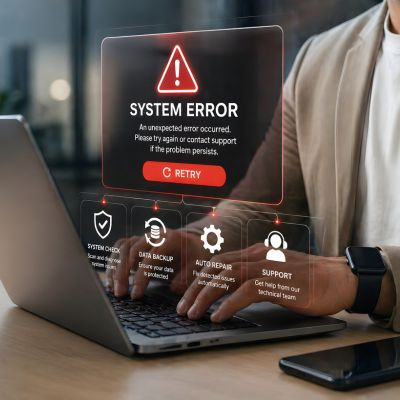
When something in your office breaks, you call your IT guy, he fixes it, and he sends you a bill. It feels straightforward enough, but this standard arrangement hides a massive conflict of interest. Your tech provider only makes money when your business is actively suffering from downtime, which feels decidedly more like a “trick” than a “treat.”
0 Comments

When everything in your office is running smoothly, looking at a monthly IT invoice can feel like paying for an insurance policy you never use. It is completely natural to wonder why you are paying a retainer when nothing seems to be broken.
Believe it or not, that quiet stability is actually the entire point of preventive maintenance.

Landing a major contract or watching sales surge should mark a high point for your business. For many owners, however, sudden growth quickly triggers an operational crisis. Systems lag, communication breaks down, and critical workflows fracture simply because infrastructure built for a team of ten cannot support a workforce of fifty.
Fixing tech bottlenecks reactively is an expensive mistake. Waiting until systems fail forces you to spend twice as much on emergency fixes as you would have on proactive upgrades. Scaling your technology sustainably comes down to a few core operational shifts.

Many small business owners assume their size keeps them invisible to modern cybercriminals. In reality, automated bots scan networks indiscriminately for unpatched software and weak passwords each and every second. You are not targeted for who you are, but for how easily your system can be breached.

Think of your business data as the lifeblood of your operations. It's everything from customer lists and financial records to project files and that brilliant marketing plan you spent weeks perfecting. Now, imagine that lifeblood suddenly… vanishes. Sounds like a nightmare, right?

When a central server dies, your business operations come to a complete standstill. Most owners take comfort in knowing they have a nightly backup running in the background. However, having your files saved on an offsite drive is only half of the equation when downtime strikes.

Most business leaders assume that securing a network is purely a defensive game: locking down access points so outsiders stay out. A far more compelling argument for a tight network configuration is operational harmony and bandwidth preservation.
When your primary network is a free-for-all crowded with personal smartphones, guest tablets, and smart appliances, your mission-critical operations suffer. Protecting your Wi-Fi isn’t just about stopping malicious intruders; it's about actively carving out a high-performance, frictionless digital highway for your core business systems. Here is how strategic router adjustments protect both your data security and your daily workflow productivity.

Summer vacations are essential for employee well-being, but they also introduce a critical operational risk: when leaders, executives, and internal IT personnel take time off, your standard business defenses naturally soften.
Cybercriminals do not take summer vacations. In fact, the threat actor's strategy is built entirely around exploiting these seasonal staffing gaps. Hackers know that standard verification processes break down when an office is operating with a skeleton crew. When the usual decision-makers are offline, employees left behind are more likely to make quick, unverified choices under pressure.

The rise of artificial intelligence has fundamentally changed the cybersecurity game for small and medium-sized businesses. Cybercriminals now use generative AI to launch rapid, highly automated attacks that easily slip past traditional, outdated security software. As such, business owners must adapt quickly to protect their networks and financial assets from these advanced digital threats.

As a business owner, you probably manage hundreds of different online accounts. Best practices say you should have a unique password for each one! That's a lot to handle, but it is an essential rule that each and every member of your team needs to follow. A standalone password manager is a super useful tool to help with this… as long as you can get your team’s buy-in.
Let’s work through it together.
Chances are you’ve seen the update window out of the corner of your eye while you’re going about your day-to-day tasks. For most employees, the choice is easy. They can click “Remind me later” to make today’s problem tomorrow’s. This creates a patch gap, which inadvertently becomes a major security hole for your small business.

A friend of mine runs a successful firm, and like many owners, he’s been looking for ways to trim overhead. He told me, with a bit of a proud grin, that he saved a few thousand dollars this year by simplifying his IT stack and letting go of his managed security plan in favor of a basic off-the-shelf antivirus.
He asked me if it was all essentially the same stuff anyway.

If you feel like your to-do list keeps growing every day, you aren’t alone. For many entrepreneurs, the day feels like a losing battle against the clock, switching from sales spreadsheets to marketing plans until your brain feels like it has too many tabs open.

Running a small business in 2026 means you are essentially running a technology company, regardless of what your business is. The digital backbone of your operation—your payment processors, inventory systems, and customer databases—has become incredibly sophisticated, but that sophistication often brings a new level of technical headache. If you have recently heard the term AIOps and felt a wave of fatigue, you are certainly not alone.

Generative AI is no longer just the cool new thing; it’s a powerful tool for business growth that organizations like yours should be leveraging. If you don’t use AI, you’ll be at a disadvantage compared to your competitors who do, and that’s no good. That said, there’s a massive difference between those who dabble in AI and those who use it masterfully, and that difference is going to grow more significant over time.
Today, we’ve got five tips to help you use AI in a proficient way so you can beat out the competition.

As a business scales, a break-fix mentality becomes a massive anchor. It may have worked when you first hung out your shingle, but you aren’t just managing laptops anymore; you’re managing cybersecurity threats, cloud migrations, and data compliance.
This is where Managed Services Providers (MSPs) come in. The MSP may be an outside contractor, but it really is a specialized engine you plug into your business to handle the technical stuff.

If you’re an SMB owner, you probably think your biggest overhead is rent, payroll, or inventory. You’re wrong.
Your biggest hidden expense is the friction tax: the literal dollars leaking out of your bank account every time a 12-person email thread lands in an inbox. Most business owners treat IT like a utility, but if your team is still collaborating via CC’d emails and messy threads, you aren’t running a modern business. You’re running a digital archaeological dig.

One of the biggest myths out there related to cybersecurity is that criminals only go after the big enterprises. Why should they care about your small operation, anyway? In reality, cybercriminals love to attack small businesses to take advantage of their weaker security infrastructures. If you’re not careful, this could lead to serious losses for your business stemming from a loss of trust, legal fees, and operational downtime.

Did you know that industry data suggests that the average small business loses over $10,000 per year simply by making “common-sense” IT decisions that lack a long-term strategy? In fact, most IT decision-makers look at technology as little more than a utility, like water or electricity, rather than a competitive advantage. IT is not a cost to be minimized; it’s a way to get ahead (and stay ahead), and it’s time to fix the mistakes you’ve made in the past.

We talk about VoIP like it’s a magic bullet for small businesses—and it often is. But here is the catch: it is not a set-it-and-forget-it solution. To get the actual value out of your investment without driving your employees and clients to the brink of frustration, you need precision and planning.
If you are looking to upgrade your communications, here are three critical implementation hurdles you need to clear to ensure your transition is seamless.
Mobile? Grab this Article